Chess poisoning
The Royal GameChess poisoning is Dr B’s name for the pathological mental over-exertion that overtakes him after months of isolation and chess played only in his imagination. Chess first gives him a structured defense against the void of solitary confinement; when he tries to become both opponents in an endless contest against himself, that defense changes into an obsession that threatens his mental balance and later makes even one real match dangerous.
Meaning and Origins
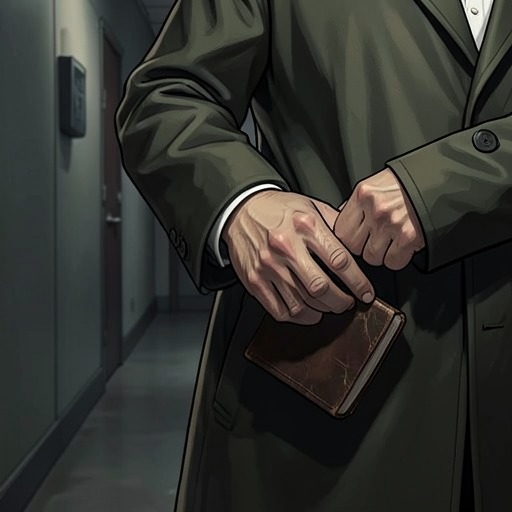
Dr B is detained in the Gestapo headquarters at the Hotel Metropole, where the isolation imposed on prisoners held for information is presented as a more sophisticated form of interrogation. Alone in a room stripped of books, writing materials, and ordinary human contact, he turns to a stolen chess almanac containing 150 grandmaster matches. He learns to replay its games from memory, and the activity gives his days a fixed pattern and his thinking renewed discipline. While he is reproducing other players’ matches, he remains a spectator to their contest; their moves give his attention an ordered task without making his own self the opponent.
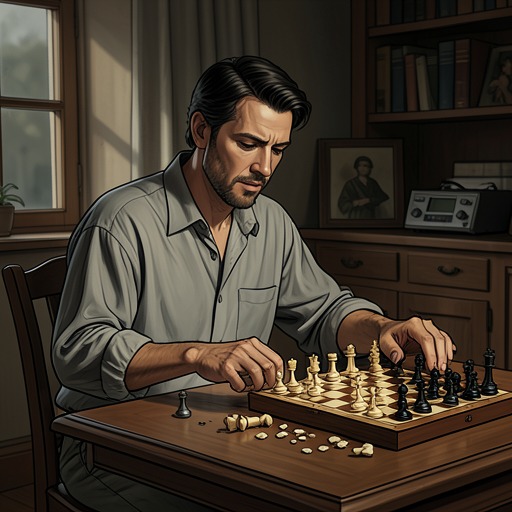
The change begins when Dr B exhausts the almanac’s games and has no new ones to replay. He recognizes the contradiction at the heart of playing chess against oneself: the same mind must devise a move and then respond as though it did not already know the plan. He nevertheless attempts to divide himself into a black self and a white self, believing that this mental division may keep him from succumbing to the emptiness around him. The effort is not a continuation of the earlier, calming practice. Instead of following an existing match, he must invent one, and both sides of his divided attention become invested in winning.
From Discipline to Compulsion
At first, Dr B can pause between games and recover from the effort. That control soon gives way: each self urges the other onward, each defeat demands revenge, and he plays match after match. He estimates that in the final months of confinement he may have played a thousand games or more. His description of the escalation is also a description of its narrowing effect: the occupation that had filled otherwise empty time comes to occupy almost all of his waking thought, and it follows him into sleep.
The compulsion displaces ordinary needs and routines. Dr B becomes impatient with interruptions, including the warder’s brief visits to clean the cell or bring food; at times he leaves a meal untouched until evening. He describes intense thirst and a growing inability to sit still, pacing faster as a match approaches its conclusion. The contest’s imagined urgency becomes a physical strain as well as a mental one: he grows thinner, sleeps poorly, and experiences trembling and weakness. Yet beginning another game brings a surge of energy, and he hears himself shouting at the imagined opponents. He calls the condition chess poisoning because the activity that once restored his concentration now consumes his attention and unsettles both mind and body.
The Match Against Himself
Dr B explains that the danger lies in the structure of the contest, not simply in how many games he plays. Chess depends on two separate minds concealing their intentions from each other. In self-play, he must somehow know and not know the plan at once. His effort to sustain these opposing positions becomes, in his account, an artificial division of consciousness intensified by the anger and desire for revenge he has accumulated during captivity. The game's strict rules offer no genuine separation between the players: both sides remain within the same mind, each driving the other into a more fevered contest.
This distinction clarifies the reversal at the center of the expression. Replaying the almanac’s existing games had given Dr B a bounded occupation, a source of routine and mental exercise. Inventing matches against himself removes the external model that kept the activity contained. The formerly useful discipline turns into a demand he cannot satisfy: one imagined self must defeat the other, and each result supplies a reason to begin again. Chess poisoning names that transformation from refuge to mania rather than a simple excess of interest in the game.
Return and Recurrence
After his release, Dr B is able to recall his confinement only gradually; for weeks, he says, attempts to think back seem to meet a mental blank. On a ship, seeing a chess game between real players makes him recognize how far his cell-bound practice had departed from ordinary play. He later agrees to test whether he can play a normal game on a real board, but insists that it should be a single match, not the beginning of a new pursuit. He explains that a doctor had warned him that anyone who had once entered a mania remained at risk, and that he should avoid chess despite considering himself cured.
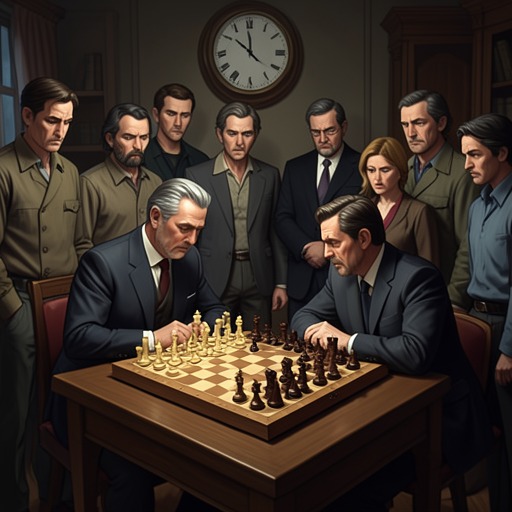
During the match with Mirko Czentovic, Dr B’s attention begins to wander from the position on the board. As the game continues, he appears absorbed in other combinations and must be brought back to the actual match after his opponent moves. At the nineteenth move he responds to the position he believes he is seeing, not the one on the board, and announces a check that is impossible because Czentovic’s king is not in that position. Dr B then insists that the king and a pawn occupy squares from another game. The error makes the recurrence visible: the boundary between the live contest and the imagined chess in his mind has broken down.
The narrator reminds Dr B of the danger and urges him to stop. Dr B regains his composure, apologizes to Czentovic and the observers, and leaves, saying it will be the last time he plays chess. The others see an inexplicable mistake and a match cut short; the narrator understands that ending the game is a safeguard against a return to the compulsion. Chess poisoning therefore reaches beyond Dr B’s confinement: even after release and recovery, the possibility of its return governs his relationship to the game.